
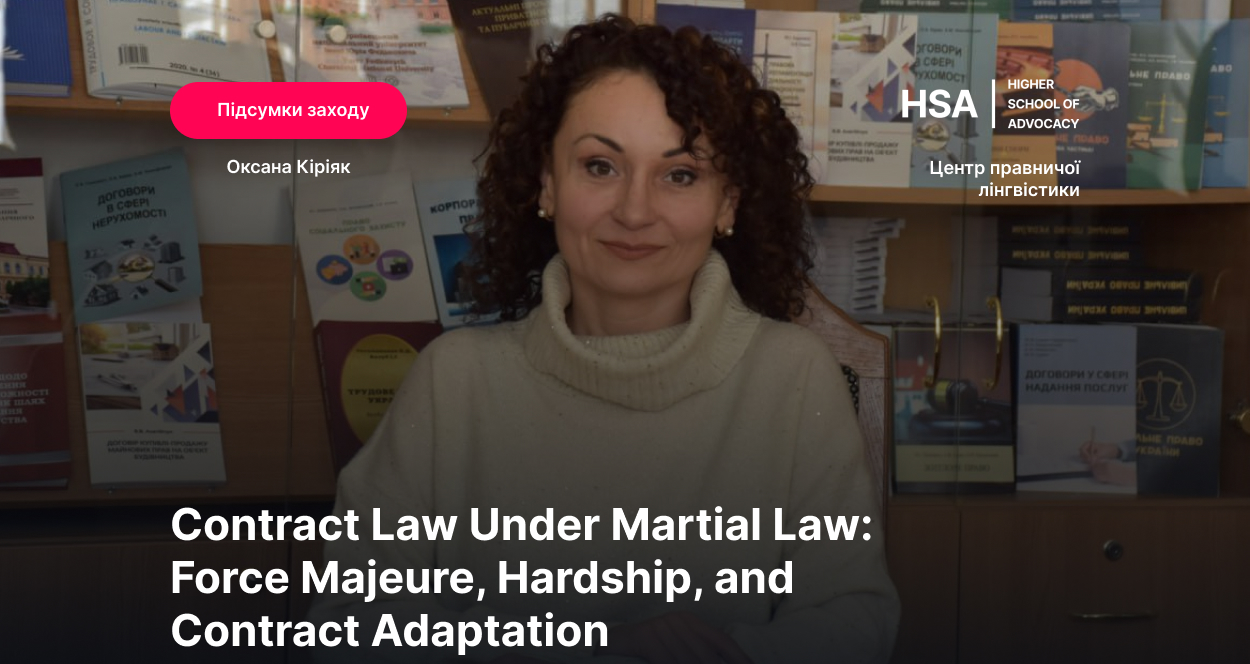
Лектор докладно проаналізувала разом з учасниками договірне право в умовах воєнного стану, а саме:
1. Legal Framework of Martial Law and Its Impact on Contracts (Правове регулювання воєнного стану та його вплив на договірні зобов’язання)
2. Force Majeure vs. Hardship: Legal Tests and Evidence (Форс-мажор та істотна зміна обставин: юридичні критерії та доказування)
3. Contract Adaptation: Suspension, Renegotiation, Termination (Адаптація договорів: зупинення, перегляд, розірвання)
4. Court Practice and Practical Drafting Recommendations (Судова практика та практичні рекомендації з договірного формулювання)
У рамках характеристики договірного права в умовах воєнного стану акцентовано на наступному:
1. Legal Framework of Martial Law and Its Impact on Contracts
Defines martial law as a legal reality that directly affects contractual performance under wartime conditions. In this context, the central legal mechanism is the doctrine of force majeure.
Force majeure is described as an unforeseeable and uncontrollable event arising after the conclusion of a contract, which renders contractual performance impossible, impracticable, or commercially unreasonable.
Force majeure clauses are commonly incorporated into contracts in order to determine the events that may excuse parties from performing their obligations. Such events include:
● natural disasters;
● acts of war;
● government actions;
● other extraordinary circumstances beyond the parties’ control.
Specifically emphasizes that acts of war constitute a classic force majeure event. Suggested contractual language includes definitions such as:
● declaration of war;
● armed conflict;
● military invasion;
● hostilities;
● insurrection;
● acts of aggression by state or non-state actors.
The legal consequences of force majeure under wartime conditions may include:
● excuse from contractual performance;
● suspension of obligations;
● delay of performance;
● relief from liability for non-performance or delayed performance;
● mitigation duties;
● notification obligations.
Also refers to relevant European Union legislation:
● European Union Consumer Rights Directive (2011/83/EU), which addresses situations where consumers may be released from contractual obligations due to circumstances beyond their control;
● Public Procurement Directives (2014/24/EU and 2014/25/EU), which may contain provisions related to force majeure in public contracts.
The material further demonstrates that wartime disruptions may affect:
● supply chains;
● infrastructure;
● energy systems;
● regulatory compliance;
● delivery of goods and services.
The Fukushima Nuclear Disaster (2011) and Hurricane Katrina (2005), where force majeure clauses were invoked because extraordinary events prevented contractual performance.
2. Force Majeure vs. Hardship: Legal Tests and Evidence
Force majeure is characterized by the following legal elements:
1. Unforeseeable event. The event must be beyond the control of the parties and incapable of being reasonably anticipated or prevented.
2. Impact on performance. The event must excuse, delay, or suspend contractual obligations.
3. Exclusionary clause. Contracts often contain a closed list of qualifying events. Events not listed may fall outside the clause.
4. Notice and mitigation obligations. The affected party must notify the counterparty and take reasonable measures to mitigate the consequences.
Evidence-related requirements in the presentation include:
● written notice to the other party;
● detailed explanation of the force majeure event;
● demonstration of direct and material impact on performance;
● proof of mitigation efforts;
● objective interpretation of qualifying events.
Hardship is defined as a situation where unforeseen events fundamentally alter the economic balance of the contract, making performance excessively burdensome, although still possible.
The UNIDROIT Principles of International Commercial Contracts, according to which hardship exists where events fundamentally alter the equilibrium of the contract either because:
● the cost of performance has increased; or
● the value of the performance received has diminished.
Identifies the core characteristics of hardship:
1. The change occurs after contract conclusion;
2. Unforeseeability;
3. Circumstances beyond the control of the affected party;
4. Fundamental imbalance;
5. Performance remains possible.
Therefore, the key distinction between force majeure and hardship is the following:
● under force majeure, performance becomes impossible, impracticable, or commercially unreasonable;
● under hardship, performance remains possible but becomes excessively burdensome due to a fundamental economic imbalance.
Also notes that hardship reflects a shift from the classical principle of pacta sunt servanda (“agreements must be kept”) toward a more flexible understanding of contractual justice.
3. Contract Adaptation: Suspension, Renegotiation, Termination
Explains that contracts may be adapted during wartime through various legal mechanisms incorporated into force majeure clauses.
Suspension of Obligations:
Suggested contractual wording provides that:
● contractual obligations may be suspended for the duration of the force majeure event;
● suspension applies only to the extent affected by the event;
● suspension occurs without liability to either party.
Repeatedly emphasizes the verb “to suspend” as a central contractual consequence of force majeure.
Delay of Performance:
Force majeure clauses may permit delay where the affected party is temporarily unable to meet deadlines or time-sensitive obligations. The presentation gives the example of construction projects delayed by extreme weather conditions.
Mitigation and Alternative Performance:
Parties should use commercially reasonable efforts to mitigate the effects of force majeure, including:
● seeking alternative means of performance;
● minimizing disruption;
● attempting substitute sourcing arrangements.
Termination Rights:
Provides model wording allowing termination where:
● the force majeure event continues for a specified continuous period;
● the event materially prevents contractual performance;
● written notice is provided to the other party.
Termination is presented as a contractual remedy applicable when suspension or delay no longer adequately addresses the disruption caused by wartime circumstances.
Renegotiation and Contractual Flexibility:
Although the presentation does not provide a detailed doctrinal framework for renegotiation, the hardship section implies contractual adaptation through rebalancing of contractual relations when economic equilibrium has fundamentally changed.
Therefore supports a flexible contractual approach in wartime conditions, including:
● temporary suspension;
● delayed performance;
● mitigation measures;
● possible termination;
● adjustment of contractual equilibrium under hardship principles.
4. Court Practice and Practical Drafting Recommendations
Mainly focuses on practical drafting guidance rather than detailed judicial analysis. However, it provides multiple drafting recommendations intended to reduce disputes and improve enforceability.
Drafting Recommendations for Force Majeure Clauses:
1. Clear definitions.
Terms such as “act of war” and “Act of God” should be expressly defined.
2. Specific examples.
Clauses should list qualifying events, including:
● earthquakes;
● floods;
● hurricanes;
● military invasion;
● hostilities;
● government restrictions.
3. Objective interpretation standards.
Determination of qualifying events should be objective rather than dependent on subjective views of the parties.
4. Notice requirements.
The affected party should promptly notify the counterparty in writing and describe:
● the nature of the event;
● expected consequences for performance.
5. Mitigation obligations.
Clauses should require commercially reasonable efforts to reduce the impact of the event.
6. Consequences of force majeure.
Contracts should clearly regulate:
● suspension;
● extension of deadlines;
● termination rights;
● relief from liability.
7. Governing law and jurisdiction clauses.
The presentation recommends expressly determining:
● applicable law;
● exclusive jurisdiction for disputes concerning force majeure and acts of war.
The concluding remarks emphasize that force majeure is a crucial legal mechanism for managing extraordinary and uncontrollable events affecting contractual obligations. According to the presentation, properly drafted clauses are essential for maintaining fair and resilient contractual relationships in unpredictable conditions such as wartime.