
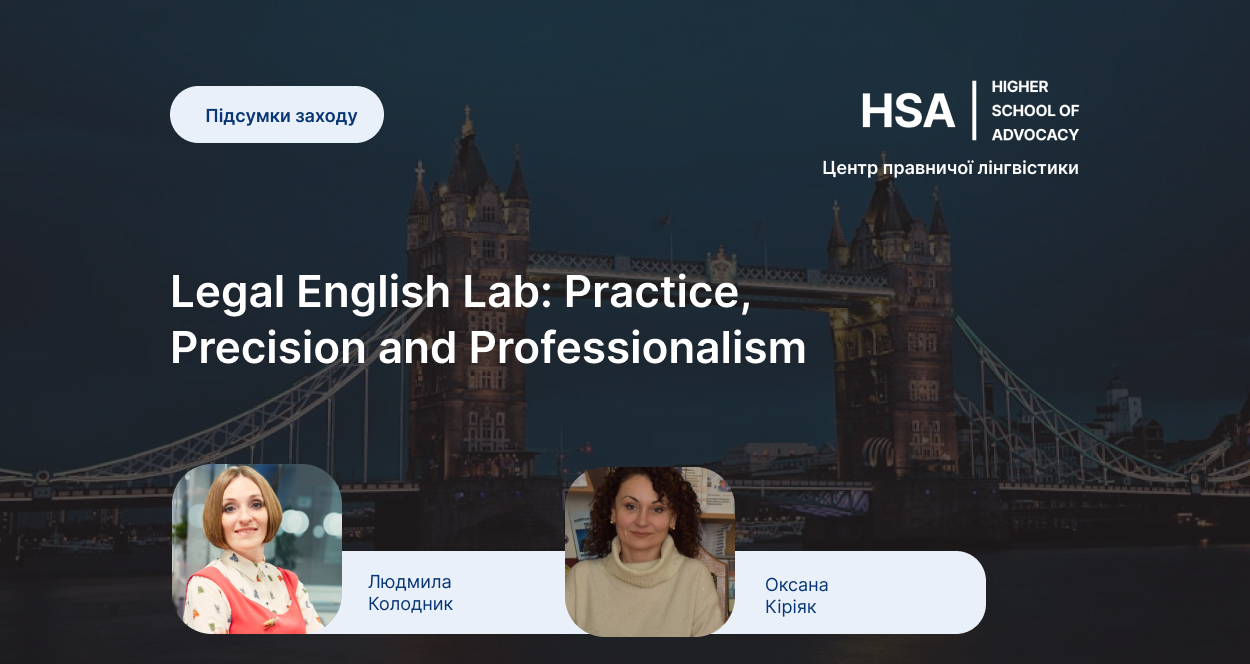
Лектори докладно проаналізували разом з учасниками юридичну англійську, а саме:
1. Вступ.
2. Ефективні методики навчання та Takeaways – практичні поради для слухача.
2.1. Practice – Precision – Professionalism.
2.1.1. Practice: робота з кейсами та автентичними документами.
2.1.2. Precision: точність термінології, модальних дієслів та конструкцій, doublets & triplets.
2.1.3. Professionalism: письмове та усне мовлення, стиль і структура текстів.
2.2. Система підготовки TOLES. Використання TOLES як тренажера для розвитку практичних навичок правника.
2.3. Blended Learning.
2.3.1. Онлайн: відео, глосарії, TOLES завдання.
2.3.2. Офлайн / Live вебінар: аналіз автентичних кейсів та контрактів, демонстраційні приклади письмового та усного мовлення, розбір помилок у документах і пояснення термінів у контексті.
3. Toolbox для слухача: лайфхаки та практичні поради щодо вивчення і покращення фахової англійської мови крізь призму основних мовних навичок: читання, письмо, усне мовлення, аудіювання та робота з лексикою.
3.1. Контекстуальний (занурювальний) підхід із застосуванням моделі Top-Down (від контексту до деталей).
3.2. Аналітичний підхід (Bottom-Up) з фокусом на терміни (від деталей до загальної картини).
3.3. Метод відтворення реальних професійних кейсів.
3.4. Обговорення судових справ: Raffles v. Wichelhaus (1864) та Frigaliment Importing Co. v. B.N.S. International Sales Corp (1960).
3.5. Акцент на прийменникових конструкціях і модальних дієсловах 4. Q&A: питання та відповіді.
У рамках характеристики юридичної англійської мови акцентовано на наступному:
1. Introduction
Legal English as a multidisciplinary field combining three domains:
· Law (legal principles, reasoning, case analysis),
· Language (grammar, vocabulary, syntax adapted to legal communication),
· Professional culture (drafting conventions, tone, structure, ethics).
It also emphasizes that Legal English is an “insiders’ language” used in interactions between lawyers and judges, containing specialized register and legal vocabulary.
2. Effective learning methodology and Takeaways – practical advice for the learner
Why a systematic methodology is crucial:
· Predictable learning outcomes,
· Elimination of chaos,
· Standardization of professional skills,
· Formation of legal thinking in English,
· Long-lasting results.
It also highlights modern innovations:
· Case-Based Learning 2.0,
· AI-assisted learning,
· Focus on drafting & editing,
· Intercultural competence,
· Microlearning.
2.1. Practice – Precision – Professionalism
2.1.1. Practice: casework and authentic documents
Practice includes:
· Working with real-life cases, judicial decisions, and authentic documents.
· Analyzing arguments, predicting outcomes, reformulating clauses.
· Drafting tasks, negotiation scenarios, and role plays.
Examples:
· Donoghue v Stevenson case analysis.
· Naturalization & citizenship cases.
· Fedorenko v United States (1981).
2.1.2. Precision: terminology, modal verbs, constructions, doublets & triplets
Precision focuses on:
· Mastery of accurate legal terminology (contracts, litigation, corporate law).
· Correct use of modal verbs and constructions: shall, may, must, hereby, thereafter, subject to.
· Understanding and managing doublets & triplets (e.g., null and void).
· Choosing clarity and conciseness over verbosity.
Also included:
· “Shall-less” drafting (using must, may, must not, should).
· Ken Adams’s approach to eliminating “shall” due to ambiguity.
· Comparative vocabulary (e.g., tax evasion vs tax avoidance; bankruptcy vs insolvency).
2.1.3. Professionalism: written & spoken communication, style and structure
Professionalism means:
· Building strong written and spoken communication aligned with legal standards.
· Structuring documents: headings, definitions, clauses, logical order.
· Using neutral, diplomatic, concise tone.
· Editing, proofreading, and refining texts.
· Avoiding legalese, long sentences, archaic expressions, unnecessary synonyms.
2.2. The TOLES preparation system. TOLES as a skills-development tool
TOLES = Test of Legal English Skills.
The certificates:
· Prove a lawyer’s level of specialized Legal English,
· Do not expire (lifetime validity).
TOLES-based system includes:
· Legal vocabulary training,
· Contract drafting,
· Case reading,
· Precision tasks,
· Grammar for lawyers (INITIATE & ACTIVATE),
· Contract formation, negligence, remedies, companies, boilerplate clauses.
2.3. Blended Learning
Blended learning = combination of synchronous and asynchronous methods.
It merges methodology, flexibility, and practical skills.
2.3.1. Online: videos, glossaries, TOLES tasks
Online component includes:
· Video lessons introducing concepts and structures,
· Glossaries for terminology building,
· TOLES-style vocabulary, reading, precision tasks,
· Independent modules for consolidation and revision.
2.3.2. Offline / Live webinar: case analysis, contract work, examples of communication, error correction
Offline or live webinar training includes:
· Analysis of authentic cases, contracts, court documents,
· Demonstrations of effective written and oral communication,
· Error-correction workshops using real documents,
· Contextual explanations of terminology and reasoning,
· Interactive practice: drafting, issue spotting, argumentation.
3. Toolbox for the learner: lifehacks and practical advice for improving Legal English skills (reading, writing, speaking, listening, and vocabulary work)
General skill-development principles:
· Shadow real documents, not textbooks: contracts, court decisions, statutes.
· Listen to legal English: UK Supreme Court hearings, arbitration recordings, podcasts.
· Use parallel reading of common-law and civil-law documents to notice linguistic and conceptual differences.
· Practice daily with a “legal sentence of the day”, analyzing connectors such as whereas, provided that, subject to.
· Learn legal language like Lego blocks — by assembling standard structures, not memorizing wordlists.
· Focus on avoiding common mistakes: passive voice overuse, literal translation, misuse of shall, misunderstanding notwithstanding, incorrect equivalents.
Skill-specific tools:
Reading:
· Use authentic legal sources and decipher meaning from context.
· Compare Ukrainian and English versions of the same type of legal document.
· Build a definitions map so the contract becomes a visual structure.
Writing:
· Simulate real professional tasks: drafting simple contracts, board resolutions, corporate policies, legal memoranda.
· Focus on structure, precision, and eliminating literal translation.
· Treat legalese as a risk-management tool: always ask who is protected, who carries the risk, and which scenario the clause prevents.
Speaking:
· Shadow authentic hearings and adopt the rhythm of legal English.
· Participate in bilingual legal drafting groups.
· Practice explaining terms and clauses aloud to improve fluency.
Listening:
· Listen to recorded trials, arbitration proceedings, legal podcasts.
· Internalize the cadence, intonation, and standard formulations.
Vocabulary:
· Learn terms in context, not in isolation.
· Practice connectors, standard clause openers, and prepositional structures: liability for, breach of, payment to.
· Pay attention to near-synonyms and false equivalents: договір приєднання ≠ adhesion contract automatically.
3.1. Contextual (immersive) approach – Top-Down model (from context to details)
According to the presentation, the Top-Down approach includes:
· Learning legal language through real legal texts: contracts, court decisions, statutes.
· Deciphering meaning from context, including cultural and procedural background.
· Seeing how terms function within authentic legal situations.
· Commonly used in case method and professional translation practice.
This approach emphasizes immersion first, definitions later.
3.2. Analytical approach – Bottom-Up (from details to the general picture)
The Bottom-Up approach focuses on:
· Studying individual terms, phrases, and grammar structures in isolation.
· Building a precise vocabulary base before engaging with complex documents.
· Using structured courses and bilingual dictionaries.
· Ensuring grammatical accuracy and formal consistency prior to contextual application.
This model is rule-first, context-second.
3.3. Method of reproducing real professional cases
Simulating real legal tasks, such as:
· Drafting simple contracts,
· Preparing a legal memorandum,
· Creating a corporate policy or code of conduct,
· Writing a board resolution.
These exercises mirror the tasks lawyers perform daily, helping learners adopt authentic structures, tone, and reasoning.
3.4. Discussion of legal cases: Raffles v. Wichelhaus (1864) and Frigaliment Importing Co. v. B.N.S. International Sales Corp (1960)
Raffles v. Wichelhaus (1864) — “The Peerless”:
· Contract for cotton shipment on a ship named Peerless.
· There were two ships with that name (October vs December).
· Each party meant a different ship.
· Court held there was no meeting of the minds, so no binding contract.
· Demonstrates how ambiguity destroys contractual consensus.
Frigaliment v. B.N.S. (1960) — “What is chicken?”:
· Dispute: whether “chicken” meant only young broilers or any bird of that genus meeting weight/quality criteria.
· Dictionaries supported both meanings.
· Holmes’s principle applied: contract formation depends on external signs, not inner intentions.
· Court ruled plaintiff failed to prove narrower meaning.
· Key lesson: seemingly ordinary terms must be clearly defined if they carry legal significance.
These cases illustrate how linguistic ambiguity affects contracts and why definitions matter.
3.5. Focus on prepositional constructions and modal verbs
Modal verbs:
· shall = obligation;
· may = permission;
· must = strong, non-negotiable duty;
Misuse of shall is listed among common mistakes.
Prepositions change legal meaning, e.g.:
· liability for,
· breach of,
· payment to.
Mastering them helps understand legal relationships and obligations.
4. Q&A: Questions and Answers
1) What is the most effective way to learn Legal English?
The presentation emphasizes a hybrid learning method, combining the Top-Down (contextual/immersive) approach—working with authentic contracts, cases, and statutes—with the Bottom-Up (analytical) approach, which focuses on terminology, structures, and grammar first. Together, they create both precision and contextual understanding.
2) How should learners improve all core skills—reading, writing, listening, speaking, and vocabulary?
The recommended strategy is to work with real legal materials: shadow authentic contracts, court decisions, and statutes; listen to recorded hearings and legal podcasts; simulate real professional tasks (drafting a memo, contract, policy); and study vocabulary in context rather than through memorization.
3) Why is it important to study prepositions and modal verbs?
Small words produce major legal consequences.
· shall = obligation,
· may = permission,
· must = strict duty.
Prepositions such as liability for, breach of, payment to define legal relationships and responsibilities.
4) What do the cases Raffles v. Wichelhaus and Frigaliment v. B.N.S.illustrate?
Both cases show how ambiguity in language can affect contract formation and interpretation.
· Raffles demonstrates a lack of “meeting of the minds” due to unclear context (two ships named Peerless).
· Frigaliment illustrates the need to define even ordinary words (“chicken”) when they carry legal significance.
These cases teach learners to define terms clearly and rely on objective signs rather than subjective intentions.
5) What are the most common mistakes in Legal English?
The presentation identifies:
· overuse of passive voice,
· literal translation instead of conceptual translation,
· misuse of shall,
· misunderstanding of notwithstanding,
· false equivalences when translating Ukrainian legal terms.
6) How can learners train daily without spending too much time?
Use the “Legal Sentence of the Day” technique: take one complex sentence, analyze its connectors (whereas, provided that, subject to), and rewrite your own version. Consistent short practice (15 minutes daily) is more effective than long, infrequent study sessions.
7) Why is Legal English considered a risk-management tool?
Legal English is not just vocabulary—it distributes risk. Every clause raises questions such as:
· Who is protected?
· Who bears responsibility?
· What scenario is this clause trying to prevent?
Understanding this perspective helps learners write clearer and safer documents.
8) What resources does the presentation recommend?
· UK Supreme Court hearings,
· Arbitration proceedings,
· Legal podcasts (including the Frigaliment case),
· Parallel reading of common-law and civil-law documents,
· Bilingual legal drafting groups.