
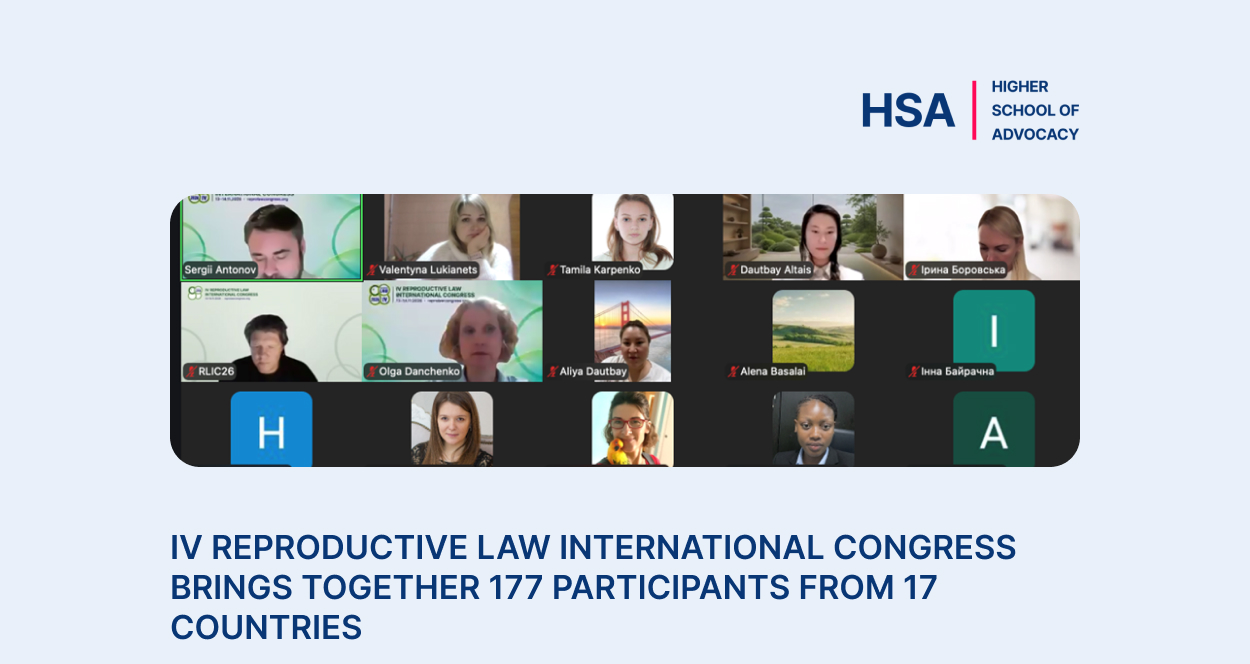
IV Reproductive Law International Congress Brings Together 177 Participants from 17 Countries
On 13–14 November 2026, the IV Reproductive Law International Congress took place under the theme “Reproductive Law and Reproductive Medicine in the Era of Digital Transformation and Artificial Intelligence”. The Congress brought together 177 unique participants from 17 countries, while 38 experts delivered academic and practice-oriented presentations.
Held online over two days, the Congress served as an international forum for interdisciplinary dialogue among academics, legal practitioners, physicians, embryologists, bioethicists and representatives of professional organisations working in the field of assisted reproductive technologies (ART).
The Congress was streamed on its YouTube channel and across social media platforms, enabling a wider audience to follow the presentations and discussions beyond the online conference itself.
According to the final Congress programme, the speaker line-up represented 15 countries: Ukraine, Australia, the United Kingdom, Denmark, Israel, Spain, Italy, Kazakhstan, Cyprus, Nigeria, Germany, the United States, France, Czechia and Switzerland.
The Congress was organised by the Scientific and Expert Centre for Medical and Reproductive Law; the All-Ukrainian Foundation of Companies Providing Organisational and Legal Support of Assisted Reproductive Technologies; and the Department of Civil Law of the Educational and Scientific Institute of Law, Taras Shevchenko National University of Kyiv.
The event was held in partnership with the National Academy of Management and the Family Law Centre of the Higher School of Advocacy of the Ukrainian National Bar Association.
The scientific programme addressed a broad range of contemporary legal and medical issues, from the development of national legislation and international regulation of surrogacy to artificial intelligence, the protection of genetic information, reproductive autonomy and safeguards for the rights and legitimate interests of participants in ART programmes.
Representatives of Taras Shevchenko National University of Kyiv made a significant contribution to the scientific programme. Speakers from the University included Professor Olena Kokhanovska, Professor Roman Maidanyk, Associate Professor Olena Hryhorenko, Associate Professor Ievhen Riabokon and Associate Professor Kateryna Moskalenko. Their presentations explored private-law regulation of reproductive relations, posthumous reproduction, reproductive autonomy in wartime, the legal status of a conceived but unborn child, and judicial protection of reproductive rights.
Particular attention was paid to the digital transformation of reproductive medicine. Discussions examined the legal and ethical implications of artificial intelligence in clinical embryology, the digitalisation of gamete banks, protection of personal and genetic data, management of technological risks, and the limits of legal liability in the use of algorithm-supported decisions in clinical practice.
A substantial part of the international dialogue focused on cross-border surrogacy, recognition of legal parentage of children born through ART, the best interests of the child, legal aspects of gamete donation and opportunities for further international cooperation.
Dedicated sessions also addressed bioethical questions in reproduction, human reproductive rights, prevention of abuse in ART programmes, patient safety, and the professional liability of healthcare professionals and other participants in reproductive arrangements.
A key feature of the Congress was an expert discussion entitled “Death of a Surrogate Mother in a Cross-Border ART Programme: Protection of Participants’ Rights and Dignity, Legal and Organisational Consequences”. Based on a hypothetical case, the discussion examined the rights of the child, the deceased woman’s family and intended parents, relevant cross-border legal issues, coordination among clinics, agencies and legal advisers, as well as liability and appropriate documentation.
The Congress also included a session for young researchers, students and early-career professionals, providing an opportunity to present their research and contribute to an international academic discussion on reproductive law and medicine.
The international composition of the Congress and the diversity of disciplinary perspectives facilitated substantive exchanges on current challenges, practical experience and promising directions for future research.
The IV Reproductive Law International Congress underscored the importance of an interdisciplinary approach to contemporary reproductive medicine and the continued development of legal frameworks capable of responding to rapid technological change while ensuring effective protection of human rights.
Following the Congress, an electronic collection of presentation abstracts will be prepared and published in PDF format. The organisers also plan to edit and publish video recordings of selected outstanding presentations on the Congress YouTube channel, making key contributions accessible to a wider professional audience.
The Organising Committee was chaired by Sergii Antonov, PhD in Law, LL.M., MBA, Director of the Scientific and Expert Centre for Medical and Reproductive Law. Kateryna Moskalenko, PhD in Law and Associate Professor at the Department of Civil Law, Educational and Scientific Institute of Law, Taras Shevchenko National University of Kyiv, served as Secretary of the Organising Committee.
Official Congress website: https://reprolawcongress.org/